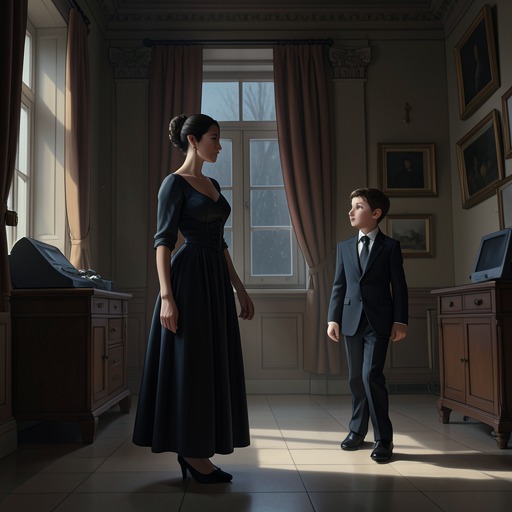
Giulia Portalupi Florio
The Florios of SicilyGiulia Portalupi Florio is Vincenzo Florio’s partner, wife, and the mother of his children. Her place in the family is shaped first by limited power over her own future and later by the struggle to secure recognition for herself and her daughters. The relationship that begins under unequal conditions becomes a lasting bond, but its durability does not erase the years in which Vincenzo’s authority left Giulia and their children without secure standing. As the family’s position rises, she becomes both its emotional anchor and a critic of the way its ambitions can reproduce the injustices she endured.
Identity and Background
Giulia’s letters show a young woman conscious of the limits placed on her and wary of Vincenzo’s claims upon her. She tells him that he is one of her father’s business associates and has no claim on her; she objects to his attentions as indecorous and asks him not to write unless his intentions are honorable. At the same time, she admits that she is not indifferent to him and that his proximity unsettles her. The letter does not resolve the contradiction between her resistance and her feelings. Instead, it makes visible how little room she has to set the terms of the relationship herself.
That unequal beginning belongs to a wider pattern of women’s constrained choices in the family. Giuseppina tells Giulia that women are treated as their husbands’ property and have no power, and Giulia later condemns the circumstances in which Giuseppina was married off at fourteen. Giulia’s own experience gives those claims personal force: she remembers years in which she lived with her children without rights, fearing that Vincenzo might cast her aside to marry a noblewoman selected by his mother. The possibility of respectable marriage and family recognition is therefore never merely private; it determines security, status, and whose wishes count.
Relationship with Vincenzo and the Question of Recognition
Vincenzo initially presents his intentions to Giulia’s family as a settlement on his terms. He says he will not marry her, but will keep her under his protection, accepts responsibility for seducing her, and asks that she not be turned out of the house. Her father calls him dishonorable and accuses him of having forced her to yield, while her brother threatens to demand compensation for her honor. The confrontation places the family’s language of honor beside the practical arrangement Vincenzo proposes: he will support Giulia, but will not give her the public marital status she seeks.
When Giulia tells Vincenzo that she is expecting his child, the news makes the future of their relationship more consequential without immediately settling it. Later, with their daughter Giuseppina in her basket, she asks him to acknowledge the girls and give them the possibility of a legitimate father. He does not agree, and she calls him a coward and tells him she does not want to see him again. Her appeal is both personal and legal in its implications: she wants the children to have a recognized place, not simply private affection or material protection.
The birth of a son changes the immediate balance. Giulia tells Vincenzo that she has given him a son and demands that he acknowledge not only the boy but also the girls; she insists that he owes that recognition to her. Vincenzo acknowledges Ignazio, Angelina, and Giuseppina as his children. A few weeks later, on January 15, he marries Giulia in a civil ceremony before a public official, followed by a church ceremony that evening. The wedding is sparsely attended: outside the family, the witnesses are Casa Florio employees. Giulia enters the household as a wife, but the sequence makes clear that recognition follows the birth of the male heir, after years in which she and the children lacked rights.
Marriage, Family, and Conflict
Marriage does not turn Giulia into a silent custodian of the family’s status. She takes responsibility for the household’s place among Palermo’s businessmen and aristocrats, even as she recognizes that the mezzanine in Via della Zecca Regia remains her true sense of home. Her new position is therefore double: she belongs to Casa Florio, yet carries the memory of the insecurity that preceded her formal entry into it.
That memory becomes decisive when Vincenzo considers advantageous matches for their daughters. Giulia objects to his offering them to wealthy associates without consulting her, and rejects the notion that they are commodities to be traded for family advantage. She recalls that for years she and the children lived without rights, uncertain whether Vincenzo would leave her to marry a noblewoman chosen by his mother. His marriage to her, she argues, came because he had a son to legitimize; had the child been another girl, she believes she would still have been excluded while he sought a different wife and heir. She refuses to let Angelina and Giuseppina suffer the same humiliation, or marry men who despise them simply to protect Vincenzo’s interests and Casa Florio.
Her objection exposes the tension between family as an affectionate bond and family as an instrument of inheritance and social advancement. Vincenzo sees an advantageous marriage as a reasonable arrangement; Giulia sees the cost borne by the daughters, whose consent and dignity risk being subordinated to the family’s calculations. She speaks not from a position outside the household but from knowledge of how those calculations once governed her own life.
Enduring Bond and Counsel to the Next Generation
Vincenzo’s trust in Giulia persists even through periods of rejection and estrangement. He thinks of her as the one person who remains attached to him, who welcomed him back after he had treated her undeservingly, and who never abandoned him. The novel’s account of their bond does not present constancy as proof that their past was fair: Giulia’s endurance coexists with her memory of exclusion, and her loyalty does not prevent her from challenging his decisions.
That history shapes her counsel to their son Ignazio when he faces a possible marriage. Giulia recalls that she chose dishonor for years in order to remain with Vincenzo and says she has never regretted that choice. But she distinguishes choosing love from accepting a relationship out of obligation: if someone is a reason for living, she tells Ignazio, hardship can be faced; if duty is the only bond, resentment and conflict may leave a couple unhappy. Her advice comes from a life in which affection and unequal power have been intertwined. It offers her son a standard she herself could not fully claim at the beginning of her relationship: a lasting partnership should rest on a real connection, not merely on social obligation.
Final Years and Narrative Significance
In Vincenzo’s final decline, Giulia remains beside him. She sits near him as he lies weakened in bed, unable to cry yet aware that grief will come. When she understands his slurred words, she recognizes that he will never tell her words of love and decides to speak for both of them. Sitting opposite him as she had when Ignazio was born, she tells him that he has loved her enough. The statement is tender, but it also carries the accumulated weight of a relationship in which love was rarely made secure through words or equal standing.
Giulia’s story closes amid the continuation of the family line: only hours after she speaks to Vincenzo, a servant arrives with news that another boy has been born, to be named Ignazio junior, assuring Casa Florio’s lineage and future. The juxtaposition joins intimate loss to dynastic continuity. Giulia has spent much of her life pressing the family to recognize the people its ambitions could leave unprotected; at the end, she remains its most steadfast companion even as the business house and its succession continue beyond her private grief. Her narrative role rests in that tension: she is both a sustaining presence within Casa Florio and the person who remembers what its pursuit of status has cost.